
Newsletter
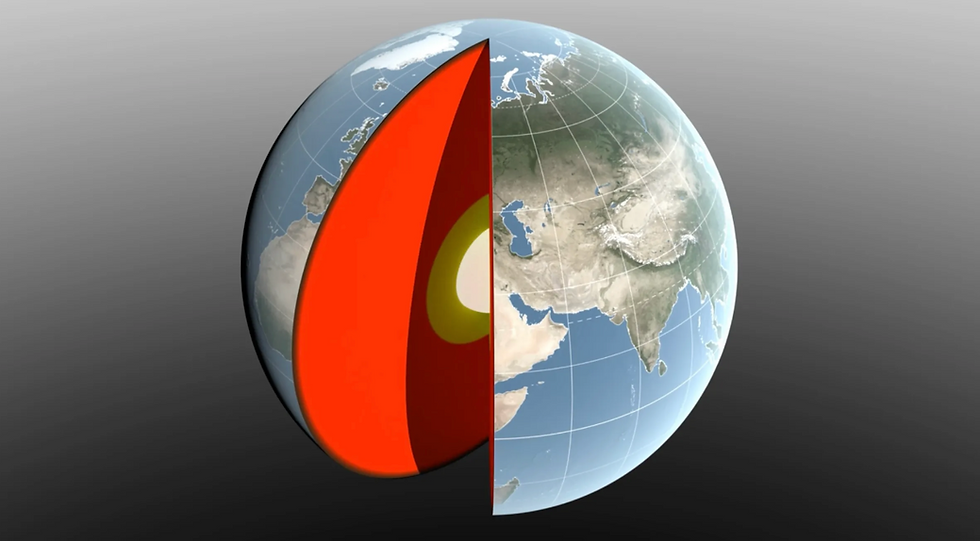
NASA Watches Earth’s Weight, Finds Center of Mass
Did you know that the Earth’s center of gravity actually shifts? Scientists just found that Earth’s center of mass is not still, and actually shifts around depending on the season. Now why does Earth’s center of gravity shift? The Earth is actually not completely uniform, and not just from the surface. For example, where there are tall mountains, gravity tends to be stronger there due to more mass being there.
But this isn't from what you can see, it's from what's under the mountains. Under the mountains, a tectonic plate is being forced downwards. That means that there is a lot of mass there, but we just can’t see it, and that shifts Earth’s center of gravity slightly. However, this shift is over the long term, millions of years. Scientists found out that it also shifts seasonally. When snow accumulates in North America and Eurasia, they found that Earth’s center of mass can shift 3 millimeters towards the North Pole. In April, when the Amazon River has the most amount of water, Earth’s center of gravity shifts towards South America. But how were these relatively small changes measured? With the help of a pair of satellites, called GRACE (Gravity Recovery and Climate Experiment Follow-On.
These satellites orbit the Earth, one in front of the other, and measure the distance between them. You might wonder, how does the distance between them show how gravity is different in places? This is for a rather simple reason. When the satellites pass over an area with higher gravity than usual, the lead satellite will be pulled ahead slightly, increasing the distance, before the trailing satellite catches up. This slight pull-ahead can be measured, and interpreted as an increase in gravity. When the area has lower gravity, the lead satellite slows down, and the distance decreases.
Add the Article's Title Here
Write a brief description of the article to spark people's interest and persuade them to read the complete article.