
Workshops
01
Erosion Workshop

Students work with a partner to build a sand hill in a tray and carve out a river channel using a spoon. After making predictions about what will happen, they use syringes to simulate rainfall — first gently, then with much more force — observing how water erodes the sand and deposits it at the bottom of the slope. Students then tackle a driving question: how could this erosion be prevented?
After testing the effect of adding rocks to their slope, they learn how rocks and plants work together in nature to protect soil. The session closes with a discussion of how erosion has shaped real landscapes over millions of years, from the Grand Canyon to river deltas — and how similar processes on Mars suggest there may once have been water, and possibly life, there too.
02
Soil Types Workshop
Students begin by examining three soil samples — sand, clay, and loam — observing how they look and feel before any experiment begins. After predicting which soil water will move through the fastest, students set up coffee-filter cups and pour equal amounts of water into each, racing to spot the first drop fall into the collection cup below. The results are striking: water rushes through sand almost immediately while clay barely drains at all. Students then connect their findings to the real world, reasoning through why cities built on clay soil are far more vulnerable to flooding after heavy rain, and why loam is the soil of choice for farming and gardening. The session closes with a discussion of porosity and permeability — big scientific words that by that point students have already discovered for themselves.
03
Fossil Workshop
Students start by exploring how imprint fossils differ from the bone fossils most people already know, learning that a creature doesn't need to survive intact to leave a permanent mark on rock. Each student receives a ball of clay, divides it into two flat disks, and presses a toy or textured object between the layers — simulating the pressure of millions of years of sediment in just 30 seconds. After carefully peeling the layers apart and removing the object, students examine the detailed impression left behind. Partners then swap fossils and try to reason out what made each imprint, mirroring exactly what real paleontologists do in the field. The session closes by tying all three workshops together — erosion, soil, and fossils are all part of the same ongoing story of how the Earth slowly and constantly changes.
04
Soil Listening
Students begin by wondering whether soil has a sound, and whether they can hear what is living inside it. After making predictions about where the soil will be noisiest and quietest, groups of three take turns using a listening device, learning first how to use the probe on a spot like moss. They then roam outside, placing the probe on grass, bare dirt, leaf litter, and under trees, recording what they hear in words, sentences, or drawings. After comparing discoveries in the middle of the session, groups head back out to test a new spot based on what they learned. The session closes by connecting the sounds to worms, beetles, ants, and microscopic creatures, and by learning how scientists use soil sounds to judge how healthy an ecosystem is.
05
Water Stratification
The workshop opens with a mystery: two identical-looking cups of water, a grape that sinks in one and floats in the other. Working as ocean scientists, students mix freshwater, medium-salinity, and high-salinity solutions in blue, yellow, and red, predict how the colors will settle, and then carefully layer them into a single cup. Once the layers form, they test where a grape floats, then stir to see how added energy mixes everything together. Students then explain what they saw using the idea of density, and connect it to real places where layers form, like estuaries and oceans, and why people float so easily in very salty places like the Dead Sea.
06
Volcanic Formations

Discover the explosive processes that build land. Students analyze real igneous rock samples, differentiating between intrusive and extrusive formations. Through tactile experiments with varying viscosities of fluids, they discover why some volcanoes erupt violently while others flow gently, shaping the diverse volcanic landscapes seen on Earth today.
Crystalline Structures
07

Uncover the hidden geometry of the natural world. In this hands-on workshop, students explore how atoms arrange themselves into the stunning, symmetrical forms of crystals. Through microscope analysis and crystal-growing experiments, we bridge the gap between chemistry and geology, revealing the mathematical beauty of the Earth's most precious formations.
Geological Mapping
08
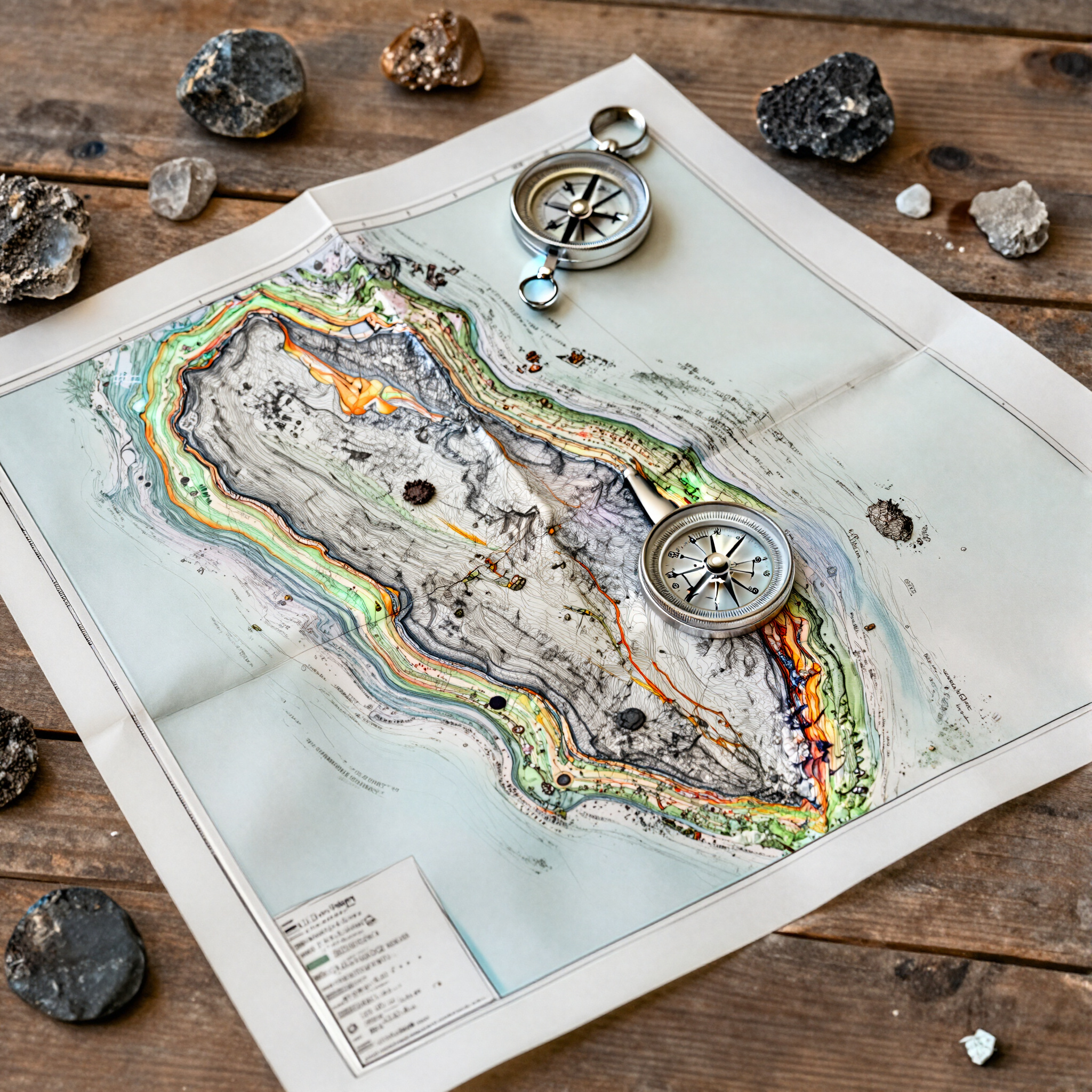
Learn to read the language of the landscape. This workshop introduces students to the essential tools of fieldwork—compasses, clinometers, and topographical charts. Participants will create their own geological maps, learning how to interpret contour lines and identify rock layers beneath the surface to predict the Earth's history and future movements.
05
Mineral Identification

Students dive into the world of mineralogy, learning to identify various specimens using professional geological tools. They perform streak tests, check for hardness using the Mohs scale, and observe crystalline structures under magnification. The workshop concludes with students categorizing their own 'mystery' minerals based on the data they've collected, just like laboratory geologists.
06
Tectonic Plates

This interactive session brings the Earth's crust to life. Using flexible models, students simulate divergent, convergent, and transform plate boundaries, observing how these movements create mountains, volcanoes, and ocean trenches. They map out the 'Ring of Fire' and discuss how understanding plate tectonics helps scientists predict geological events.
07
Water Cycle Workshop

In this immersive session, students track the journey of water through the Earth's systems. By constructing a closed-system water cycle model inside a clear laboratory flask, groups witness real-time evaporation, condensation, and precipitation. They observe how energy from a heat source drives this continuous loop and then experiment with how variations in temperature and terrain affect runoff and infiltration. The workshop scales this miniature process to the global level, exploring how the water cycle shapes weather, climate, and the survival of all living things across the planet.
08
Volcanic Chemistry

Students unlock the chemistry behind one of Earth's most violent geological events. This workshop uses safe, high-impact chemical reactions to simulate the pressure and viscosity changes that dictate whether a volcano will erupt gently or explosively. Students build their own tactile volcano models and test different ratios of reagents to observe the results, recording data on eruption height and flow rate. The session concludes with a deep dive into the chemical composition of magma and how these hidden underground reactions continue to build new landmasses and shape the Earth's surface atmosphere today.